





Contents
1.Autologous NK cell + allogeneic NK cell exosome combination therapy
Cancer treatment using NK cells is an immunotherapy that increases the attack power against cancer cells by collecting lymphocytes from the patient’s own blood, culturing them using interleukin (IL)-2, etc., expanding NK cells and NKT cells, adding active NK activation functions, and injecting them into the body. This treatment aims to help eliminate cancer cells and can be used in conjunction with conventional chemotherapy and radiation therapy.
At our clinic, in order to further increase the activity of NK cells, we inject exosomes secreted by NK cells intravenously to enhance the antitumor effect. Since it is expected to be more effective than conventional NK cell therapy, we believe it is suitable for patients whose cancer is more advanced and whose immune system is weakened.
The progress of an example is shown below.
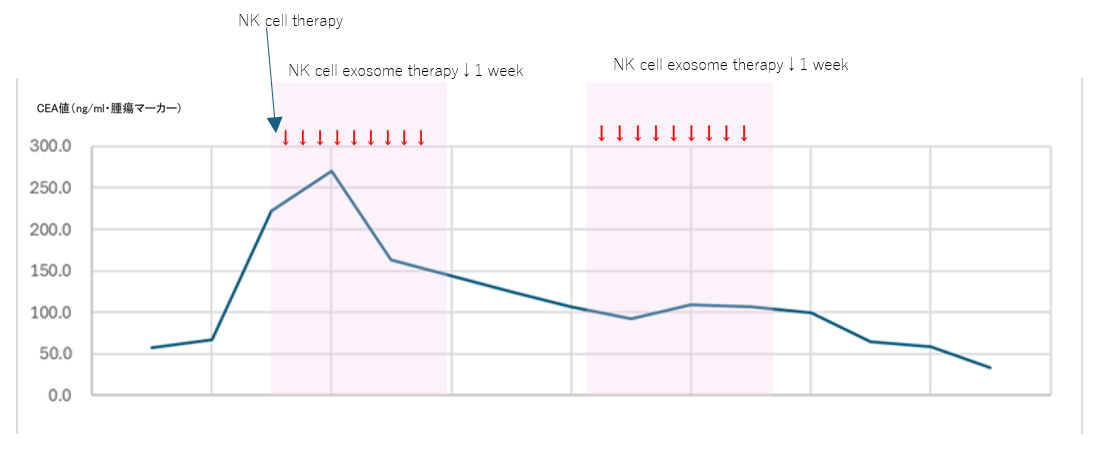
2.Cancer DNA repair (reprogramming) treatment
A low-molecular compound called Benthethonium induces microRNA (miR-520d).
miR-520d converts cancer cells into iPS (reprogramming) and transforms them into normal cells. Normalized cells divide repeatedly and eventually undergo apoptosis and disappear.
It is also expected that cancer cells will disappear, and that damaged DNA sequences will be repaired normally and that re-cancer formation will be prevented. This is a cancer treatment based on a new concept developed in the 21st century.
About side effects
Since the concentration of benzethonium chloride in DNA repair treatment is less than 0.02% and betaxolol is less than 0.1%, it is known that no adverse events occur. However, there have been reports of systemic pruritus as a side effect when administering benzethonium chloride.
NK cell + NK cell exosome therapy
| 1 course of NK cell treatment + NK cell exosome once a week for 11 weeks |
DNA repair reprogramming therapy (metoprolol or betaxolol hydrochloride)
| Contents | Add 3ml of one vial to 50ml of physiological saline and infuse 53ml at a time. |
|---|---|
| Duration | 1 course of 3 months of cancer treatment (administered twice/week) |
Macrophage activation therapy (Gc-MAF therapy)
| Contents | 4th generation Gc-MAF “ImmunoD” (administered twice/week) |
|---|---|
| Duration | Cancer treatment: 1 course of 3 months (administered twice/week) |
Saisei no Mori Clinic Roppongi original cancer immunotherapy set
Cancer Treatment Programs and Costs
For patients who have experienced local cancer recurrence after initial treatment and have been deemed unresponsive to standard therapy, or for those unable to tolerate further treatment due to severe side effects and physical frailty.
A.Enhanced Local Cancer Therapy Set using NK Cells (includes 6 NK cell therapy sessions, 6 NK exosome infusions, and 2 TAQ tests): Total 4,740,000 JPY (excl. tax)
For patients who have experienced distant metastasis or recurrence after initial cancer treatment and have exhausted other therapeutic options, or for those diagnosed with untreatable advanced cancer:
In patients with recurrent cancer, the activity of their own immune cells is significantly diminished; therefore, cell therapies that rely on expanding the patient's own immune cells may not be the most appropriate approach. Exosomes secreted by NK cells from young adults not only attack cancer cells directly but also enhance anti-tumor effects by activating the patient's own immune cells.
B.Set: 12 NK-exosome infusions + 3 Opdivo infusions
– Total: 5,700,000 JPY (excl. tax)
Cancer cells evade immune attacks by applying a "brake" to the activity of immune cells; Opdivo (generic name: nivolumab) works by releasing this brake, thereby restoring the body's natural immune function and enabling immune cells to attack the cancer cells. However, it is known that Opdivo is ineffective when the tumor-suppressor gene MLH1 is stable. Since most cancers express this gene, inhibiting MLH1 is expected to make Opdivo effective. Because NK exosomes contain microRNAs that suppress the activity of the MLH1 gene, we propose this treatment as a potential option for patients with cancers (such as colorectal or pancreatic cancer) that are otherwise considered unresponsive to Opdivo.
C.Set: 12 NK Exosome Infusions + 24 DNA Repair Treatments
– Total: 5,700,000 JPY (excl. tax)
In cancer cells, the "p53 tumor suppressor gene"—which normally halts cell proliferation—becomes functionally inactive due to abnormal methylation, leading to uncontrolled cancer cell growth. DNA repair therapy involves administering low-molecular-weight compounds to highly malignant cancer cells to activate (induce the expression of) specific miRNAs within the cells. This process reprograms the cancer cells, shifting them toward a more differentiated state—closer to that of normal cells—and reverses the methylation of the p53 tumor suppressor gene to reactivate it. These actions reduce the malignancy of the cancer cells and induce apoptosis (programmed cell death), ultimately leading to the elimination of the cancer. This treatment is recommended for patients with metastatic cancer for whom no other effective treatments remain, as well as for those with rapidly progressing, undifferentiated or poorly differentiated cancers.