


犀星の杜クリニック六本木 Forest of Regeneration Clinic Roppongi

Saisei no Mori Clinic Roppongi - Forest of Regeneration Clinic Roppongi -

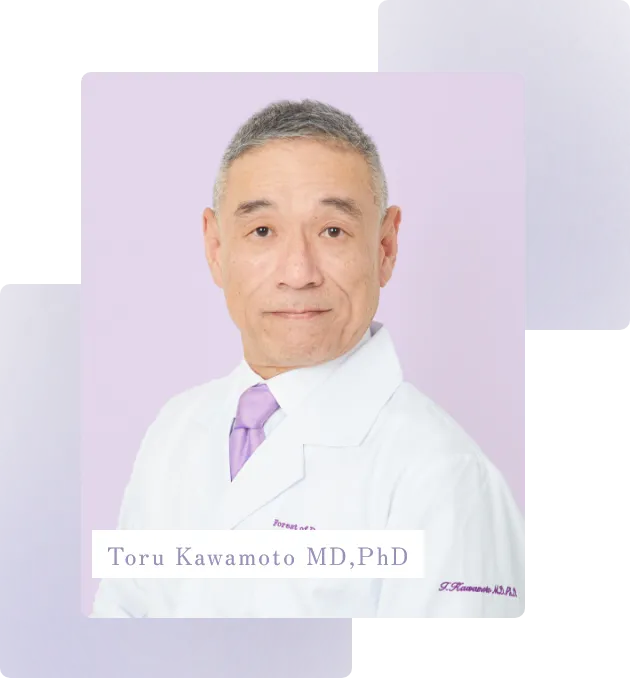
Toru Kawamoto MD,PhD

犀星の杜クリニック六本木 Forest of Regeneration Clinic Roppongi
Introduction

Introduction

当院の願い

I thought I would never find it again.
I want to go back to those days when I was in good health.
I want to work hard for 10 more years.
-We want to make your wishes come true.
That is our wish at Saisei no Mori Clinic Roppongi.

Toru Kawamoto MD,PhD

I have been practicing insurance medicine for 12 years in Shiba, Minato-ku, Tokyo. With the concept of "examining the forest for the trees," I have devoted my spare time to seeing approximately 25,000 patients every day. Thanks to your support, we are proud to say that we have fulfilled our role as a "village clinic" in the middle of this large city. In such circumstances, however, it is also true that we have been troubled by the fact that there are some diseases and conditions for which the current insurance treatment does not provide a satisfactory therapeutic effect. We were searching for a way to help the patients get well and get on the road to recovery, even if only a little. I was originally engaged in cancer research in Japan, Thailand, and the U.S. Through this relationship, I assisted in the harvesting of fat tissue for fat stem cell culture several years ago, which is how I came across regenerative medicine. After accumulating preparations, we decided to open a regenerative medicine clinic in Roppongi, which was our long-cherished dream. The clinic is located along a beautiful tree-lined cobblestone street called Ryudo-cho Museum Street, and is surrounded by a space that offers both the green and calm atmosphere of the richly ancient Tenso Shrine in front of it and the academic atmosphere of the National Art Center, Tokyo and the National Graduate Institute for Policy Studies next door. The "Saisei" of Saisei no Mori is a play on the name Saisei Muroo Saisei and rebirth, and when I close my eyes, I picture a scene of twinkling stars in a dawn sky tinted lavender gray, the color of the image of the rhinoceros. This is the moment when you feel the beginning of life. If you are on the verge of giving up, here is the regenerative medicine you have finally encountered. I would like to quickly explain the regenerative medicine we are currently performing or planning to perform at our clinic. *Regenerative medicine is a treatment using "bio-friendly physiologically active substances". Cytokines are representative of bioactive substances, which also include vitamins and hormones.

Forest of Regeneration Clinic Roppngi
Director Toru Kawamoto MD,PhD
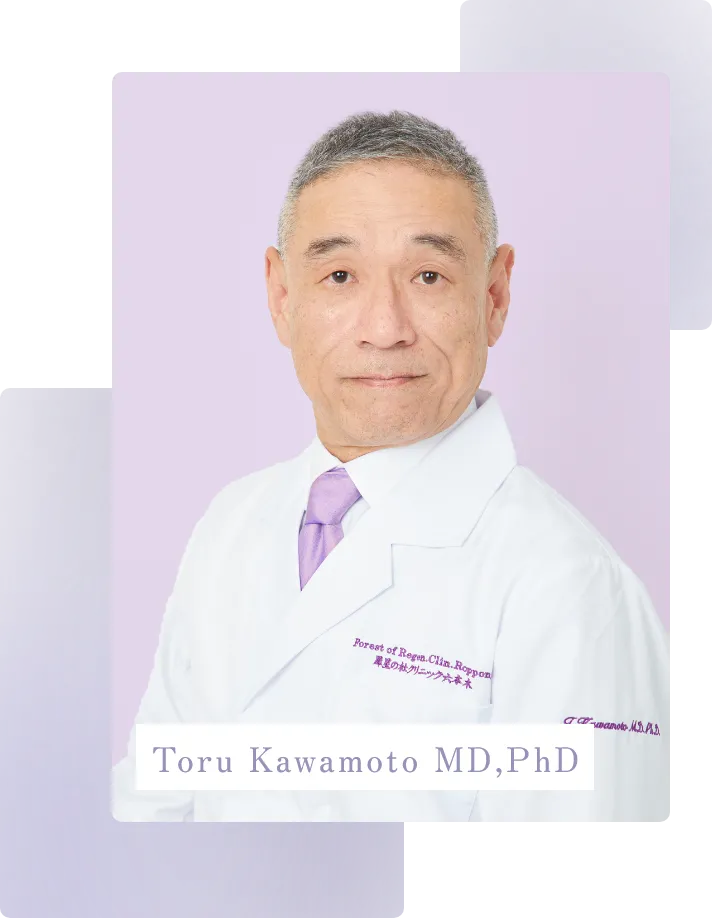
Toru Kawamoto MD,PhD

About us

Welcome to Saisei no Mori Clinic Roppongi. Another name is Forest of Regeneratio Clinic Roppongi. On behalf of the director of this clinic, I am a certified physician of the Japanese Society for Regenerative Medicine and Anti-Aging, and a member of the American Society of Clinical Oncology and the American Association for Cancer Research, with a background in cancer treatment research in the United States. Our clinic welcomes you as a world-class clinic that provide not only patient-centered medical care with the highest standards of safety, ethics, and medical excellence but also regenerative medicine based on cutting-edge medical technology and the latest scientific knowledge including iPS cell exosome treatment.

Doctor/Specialties/ Affiliated Societies

Director: Toru Kawamoto MD, PhD

  • Career History

    1987Graduated from the School of Medicine, University of Tsukuba
    1993Completed graduate studies at the University of Tsukuba Graduate School of Medicine, PhD (Medicine)
    1996Assistant professor, Department of Surgery (Gastroenterology), Faculty of Clinical Medicine, University of Tsukuba
    2003Visiting assistant professor, MD Anderson Cancer Center, University of Texas, USA
    2008Part-time assistant professor, Department of Surgery, Gastroenterology Center, Tokyo Women's Medical University
    May 2010 - PresentDirector, Minato Shiba Clinic
    2013Visiting assistant professor, Faculty of Medicine, Toho University
    October 2022Honorary Director, Minato Shiba Clinic
    November 2022Director, Saisei no Mori Clinic Roppongi
  • Specialties

    • Internal Medicine, Orthopedics, Dermatology, Oncology

    Affiliated Societies

    • American Society of Clinical Oncology (ASCO) - Full Membe
    • American Association for Cancer Research (AACR) - Full Member

Outpatient/Visiting

INFOMATION

Consultation hoursMonTueWedThuFriSatSunPub
10:00~15:00
(10a.m~3p.m)

◆12:00~15:00

▲10:00~14:00

All holidays in a whole year are closed.

What to BringPlease bring your Residence Card (Zairyu Card) or Passport.
PaymentWe accept cash, overseas remittance and major credit cards (Visa, Mastercard, American Express, JCB, Alipay and UnionPay)
RESERVATIONOur clinic operates on an appointment-only basis.
If you wish to have a consultation, please make an appointment by phone or e-mail form (roppongi@forest-regen-clin.jpn.org)
Appointment Phone Number: +81-3-3401-3141

Location/Contact/Access

Location feature
Located in Roppongi, close to the political and economic heart of Tokyo, our clinic is easily accessible from Roppongi Station and nestled in a tranquil environment surrounded by Tokyo Midtown, the National Art Center, and the Graduate School of Policy Studies, as well as the serene grounds of Tenso Shrine. We are confident that our international guests will be able to fully experience Japanese culture and find peace of mind. As a "new medical hub in the heart of Roppongi," we aim to provide medical care that enriches your future life.
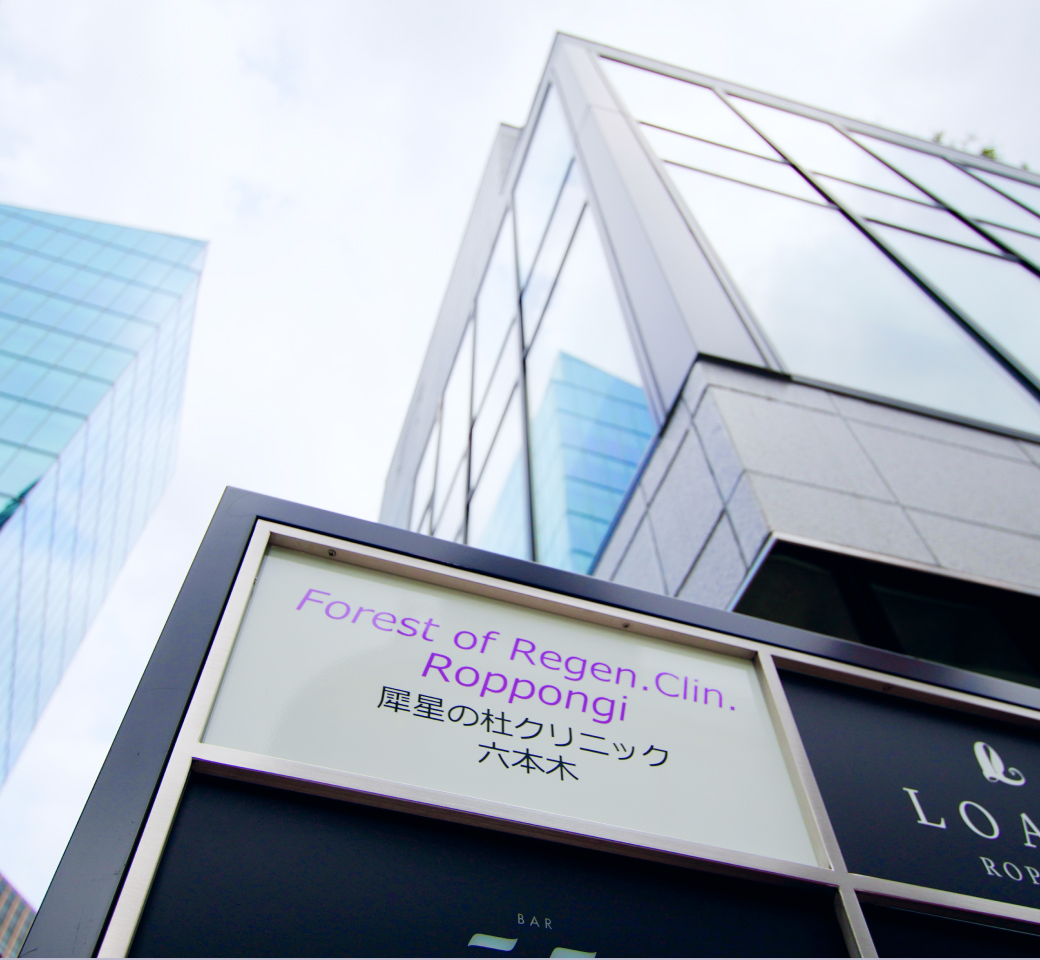
Clinic nameSaisei no Mori Clinic Roppongi (Forest of Regeneration Clinic Roppongi)
Address〒106-0032
M’s BILD.4A 7-10-1 Roppongi Minato-ku Tokyo 106-0032 Japan
Phone03-3401-3141
StationToei Oedo Line Roppongi sta. Exit 7.
3 min by walking
E-mailroppongi@forest-regen-clin.jpn.org

FAQ

1. Basic knowledge about treatment

Q What exactly is regenerative medicine?
A
Regenerative medicine is a treatment method that uses the power of cells to repair and restore tissues and organs lost due to illness or injury. Rather than suppressing symptoms with drugs, it aims for fundamental improvement by maximizing the "self-healing ability" and "regenerative power" that humans inherently possess. Stem cell therapy, the main treatment method, involves collecting cells from the patient (or another person), multiplying them, and transplanting them into damaged tissue to promote repair.
Q What symptoms or diseases can regenerative medicine be expected to treat?
A
Main target diseases and expected effects
Orthopedic diseases
Osteoarthritis: Promotes the repair of worn cartilage and tissue, aiming to reduce pain and improve joint function.
Neurological diseases
Post-stroke (cerebral infarction/cerebral hemorrhage): Promotes the regeneration of damaged brain nerve cells, supporting the recovery of motor and language functions.
Internal Medicine
Diabetes and Cirrhosis: Expected benefits include repair of damaged cells, improvement of insulin secretion, and recovery of liver function. Autoimmune Diseases and Rheumatoid Arthritis: Aims to regulate and suppress the overactive immune system, reducing inflammation and preventing progression.
Anti-Aging
Alopecia: Aims to prevent the progression of hair thinning and activate hair follicle tissue.

2. Safety and risks

Q Is regenerative medicine safe in Japan? Are there any legal regulations?
A
In Japan, regenerative medicine is conducted under strict legal regulations, such as the "Act on Ensuring the Safety of Regenerative Medicine, etc.," which is authorized by the Ministry of Health, Labour and Welfare. Regarding legal regulations, there are mainly two legal frameworks for regenerative medicine in Japan:
Act on Ensuring the Safety of Regenerative Medicine, etc.:
This law primarily regulates "medical and clinical research" provided by medical institutions. Treatments are classified into three levels according to their risk, and high-risk treatments are required to undergo review by an accreditation committee and submit a plan to the Minister of Health, Labour and Welfare.
The Pharmaceuticals and Medical Devices Act (PMD Act)
This is a law that regulates "products" manufactured and sold by companies. These products are provided as "regenerative medicine products" whose effectiveness and safety have been approved by the government.
Q What are the side effects and risks?
A
Regenerative medicine often uses the patient's own cells or blood, so it generally has fewer side effects. However, the main risks and side effects include local swelling and pain, infection, and embolism.
Local symptoms: Following injections or cell administration, pain, redness, bruising, and swelling may occur at the treatment site for several days.
Infection: There is a risk of bacterial or viral contamination at the needle insertion site or during the cell culture, manufacturing, and management processes.
Embolism: Administering large doses of stem cells can cause capillary blockage, potentially leading to serious complications.

While there is no clear evidence of tumorigenesis as a side effect, this treatment is discouraged for patients who have received treatment for advanced cancer within the past five years.
To ensure safe treatment, it is recommended to verify whether the medical institution is authorized by the Ministry of Health, Labour and Welfare.
Q Can we expect better treatment results the more adipose-derived stem cells are administered?
A
The appropriate number of adipose-derived stem cells to administer is said to be approximately 100 million to 200 million. Administering more than this, such as 300 million or 400 million, increases the number of dead cells and raises the risk of embolism. Furthermore, administering the appropriate amount several times is more effective than administering a large amount of stem cells at once. Our clinic maintains a high-quality stem cell survival rate of over 90% during administration, guaranteeing safety.

3. Regarding fees and payments

Q How much will the treatment cost?
A
For intravenous administration of adipose-derived stem cells, the first treatment costs 2.86 million yen for 100 million cells, including all examination and surgery fees, and 5.06 million yen for 200 million cells. Subsequent treatments cost 2.2 million yen and 4.4 million yen respectively. A discount is available for those receiving three or more treatments.
For local administration within the knee joint, 100 million cells cost 2.01 million yen.
For intravenous administration of NK cells, 10 billion cells cost 645,000 yen per treatment.
Q Are overseas medical insurance and travel insurance applicable?
A
Japanese public health insurance and overseas travel insurance do not cover regenerative medicine treatments performed abroad. The main reasons are as follows: Japanese public health insurance (overseas medical expense reimbursement system, etc.): Overseas travel for the purpose of treatment is not covered by the system in the first place. In addition, advanced treatments not approved in Japan are not covered by insurance. Overseas travel insurance: While the cost of treatment for sudden illness or injury is covered, "planned travel for treatment" such as regenerative medicine and "treatments in the clinical trial or research stage" are generally not covered. However, depending on the riders of your private life insurance or medical insurance, or the insurance provided with your credit card, it may be possible to receive a certain amount of benefit for "hospitalization and surgery" itself while traveling abroad.
Q Is it possible to pay by means of something other than cash, such as credit card or international money transfer?
A
Major credit cards are accepted. International money transfers can be made to the following bank account.
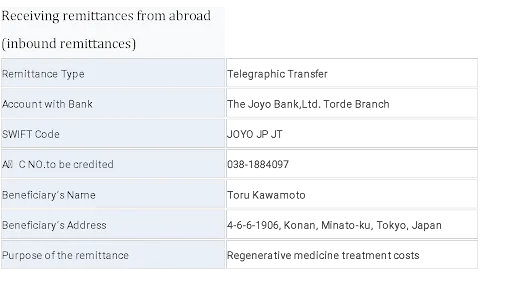
4. Stay schedule and travel information

Q How many days will I need to stay for treatment?
A
Regenerative medicine can be received on a day-trip basis, with each treatment involving cell collection and administration lasting only a few hours. Therefore, long-term, continuous hospitalization or stay is generally not required for the treatment itself. However, depending on the type of treatment and the cell preparation period, multiple visits to the clinic may be necessary.

[Typical Treatment Flow and Estimated Number of Visits/Stays] Stem cell therapy requires a minimum of two visits: one for cell collection and another for the administration of cultured cells. The cell culture period from collection to administration takes approximately 3-6 weeks. NK cell therapy also requires a minimum of two visits: one for blood collection and one for administration, with a total period of 3-4 weeks from blood collection to administration.
Q Do you offer visa support for travel?
A
Yes, if you are traveling to Japan for the purpose of regenerative medicine, you can use the support service for applying for a "medical stay visa." Obtaining it on your own is difficult, so it is common for coordinators (guarantor organizations) registered with the Ministry of Foreign Affairs to handle the document preparation and procedures on your behalf. Features and flow of medical stay visa support Use of a guarantor organization: A letter of guarantee from a Japanese receiving medical institution or a registered guarantor organization (medical coordinator or travel agency) is required for the application. Preparation of necessary documents: They will support you in arranging documents such as a "certificate of scheduled medical examination," "treatment plan," and "quotation" prepared by the medical institution. Visa for accompanying persons: In addition to the patient's visa, visas for accompanying family members who are taking care of them are often also supported. Obtaining a multiple-entry visa: If you need to visit the hospital regularly (for infusions, administrations, etc.) in multiple sessions, it is possible to obtain a multiple-entry visa valid for up to 3 years. For details of the system, please check the official page of the Ministry of Foreign Affairs Medical Stay Visa.
Q What should I do regarding aftercare following treatment, or if I experience health problems after returning home?
A
After regenerative medicine treatment, it is essential to avoid excessive exercise and alcohol consumption, and to keep the treated area at rest. If you experience any health problems such as fever or severe pain after returning home, please do not self-diagnose; first, email our clinic directly. If necessary, we will conduct an online consultation.

For several days to several weeks after treatment (depending on the treatment), please refrain from excessive exercise or running. On the day of treatment, it is generally recommended to avoid alcohol consumption and prolonged bathing (e.g., shower only). Furthermore, post-treatment follow-up consultations are available online; please request this service.

5. About medical consultations and language support

Q Is it possible to communicate in English (or your native language)?
A
The doctor can communicate in English, but an interpreter will be needed for other languages.
Q Can I bring an interpreter with me? Will the hospital arrange one?
A
We welcome guests to bring an interpreter. We can arrange for a Chinese interpreter. The fee is negotiable.
Q Are questionnaires and consent forms available in multiple languages?
A
We have it available in English and Chinese.
pagetop